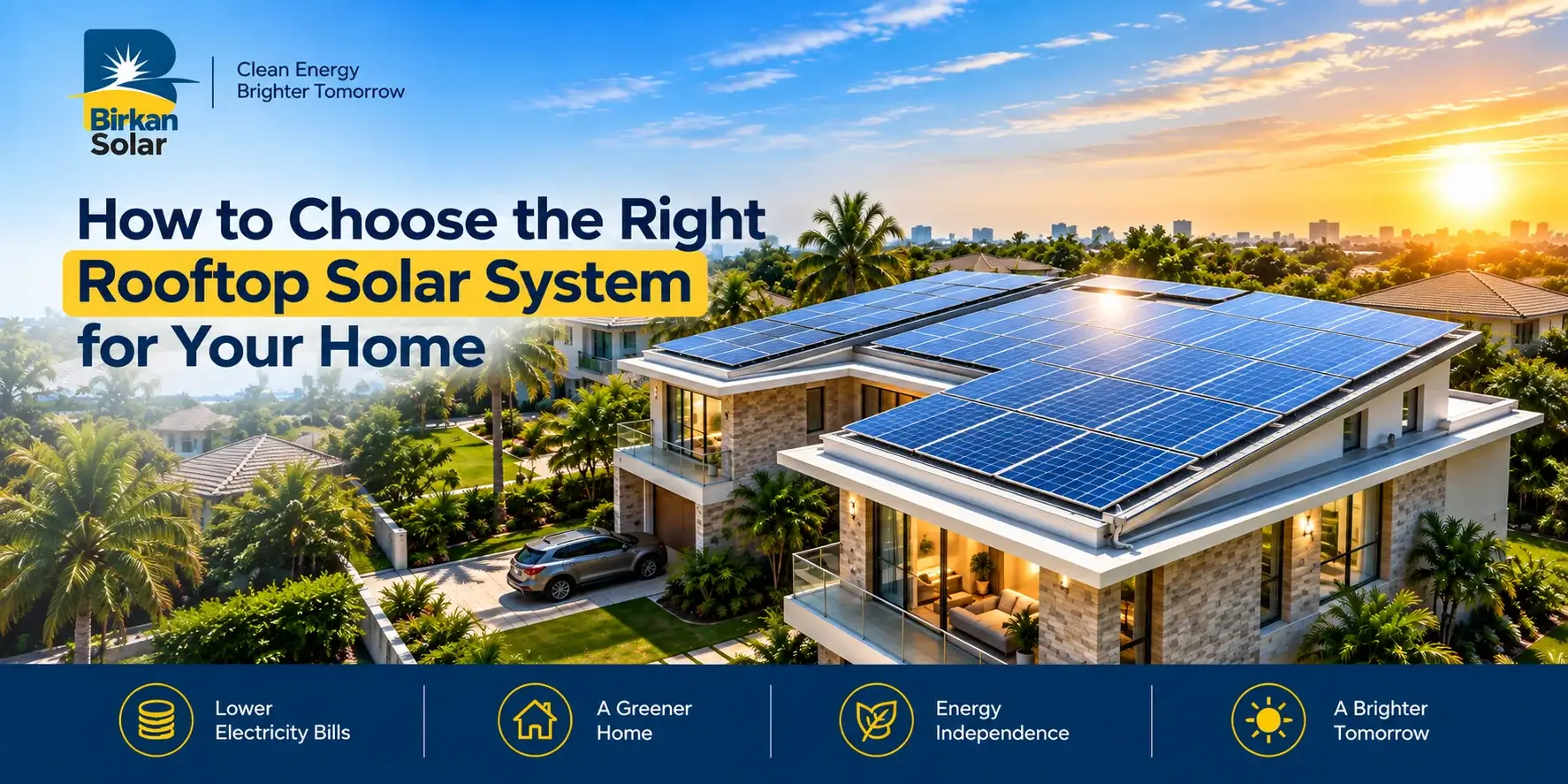
Electricity bills are becoming a regular concern for homeowners, especially when air conditioners, refrigerators, water pumps and other appliances run for long hours. A rooftop solar system for home can reduce dependence on grid electricity and help a family produce clean power from an otherwise unused roof. However, choosing a system is not as simple as selecting the highest panel wattage or accepting the first quotation.
The right residential solar system depends on your monthly electricity consumption, roof area, shadow conditions, preferred backup, local electricity rules, budget and the quality of the installation. A system that works well for one home may be too small, too expensive or poorly matched to another. This guide explains the practical factors homeowners should evaluate before investing in home rooftop solar, from system type and sizing to panels, inverters, mounting structures, installation, maintenance and long-term value.
What Is a Rooftop Solar System for Home?
A rooftop solar system for home is a set of solar panels and electrical components installed on a residential roof to convert sunlight into usable electricity. The panels generate direct current (DC), while an inverter converts it into alternating current (AC) used by household appliances. Depending on the design, the system may be connected to the electricity grid, supported by batteries, or operate independently with battery storage.
A complete home rooftop solar installation normally includes solar PV modules, an inverter, mounting structures, DC and AC cables, protection devices, earthing, monitoring equipment and the required connection or approval work. The mounting system is particularly important because it keeps the panels stable, correctly tilted and protected against wind, rain and routine roof conditions.
The objective is not only to install panels. It is to create a safe and balanced energy system that produces useful power for many years and is easy to monitor and maintain.
Start With Your Home’s Electricity Consumption
The first step in choosing a residential solar system is understanding how much electricity your home actually uses. Check at least twelve months of electricity bills if they are available. Record the monthly units consumed, the highest monthly bill, the sanctioned load and the periods when consumption rises.
Look for regular daytime loads such as air conditioning, water pumps, washing machines, kitchen appliances and home-office equipment. Solar power generated during the day can directly support these loads, which improves the practical value of the system. If most of your electricity use happens at night, battery storage or a grid-connected arrangement that allows applicable energy settlement may need to be considered.
Do not size the system only by counting appliances. Two homes with the same number of rooms can have very different consumption because of differences in appliance efficiency, usage hours, family size and seasonal demand. A professional installer should use your bills and a site assessment to recommend a realistic capacity.
How Much Rooftop Solar Capacity Does a Home Need?
A broad starting estimate is that one kilowatt (kW) of solar capacity may generate around 3 to 5 units of electricity per day in many Indian locations, depending on sunlight, season, orientation, shading, equipment and system losses. This is only an initial planning range, not a guaranteed output figure.
For example, a home using approximately 300 units per month may begin by evaluating a system in the 2 to 3 kW range. A home consuming 600 units per month may need a larger system, subject to available roof area, sanctioned load, budget and the local distribution company’s rules. The final recommendation should be based on a generation simulation rather than a simple rule of thumb.
A useful sizing conversation with an installer should answer four questions:
- What is the home’s annual electricity consumption?
- 2. How much of that consumption occurs during sunlight hours?
- 3. How much usable roof area is available without significant shade?
- 4. Is the priority bill reduction, backup power, energy independence or a combination?
Oversizing can increase upfront cost and may not deliver proportional value if the home cannot use or export the extra energy. Undersizing, on the other hand, can leave the homeowner disappointed because the system does not meet the intended target.
Choose the Right Type of Home Rooftop Solar System
There are three common system configurations. The right choice depends on how you use electricity and what you expect during a grid outage.
1. On-Grid Solar System
An on-grid system works with the utility grid and usually does not include batteries. Solar power is used by the home first, while surplus electricity may be exported according to the applicable state policy and metering arrangement. When solar production is low, the home draws electricity from the grid.
This is often suitable for homeowners whose main objective is to reduce electricity bills and who have a reasonably reliable grid connection. It normally has a lower initial cost and less battery maintenance than a backup-based system. One important point is that standard on-grid systems generally shut down during a grid outage for safety, even when sunlight is available. Homeowners who need outage protection should discuss a hybrid or backup solution.
2. Off-Grid Solar System
An off-grid system is designed for homes or sites that cannot depend on the utility grid. It uses batteries to store energy for periods without sunlight and requires careful sizing of both solar capacity and storage capacity.
Off-grid systems can be useful in remote locations, but they require more planning. The system must account for night-time loads, cloudy days, battery depth of discharge, seasonal demand and the starting current of motors or pumps. The battery bank is also a major cost component and needs appropriate ventilation, protection and replacement planning.
3. Hybrid Solar System
A hybrid system combines solar panels, batteries and the grid. It can store excess solar energy for later use and provide selected backup loads during an outage, depending on the inverter and battery design. Hybrid solar is worth considering when the homeowner wants bill savings along with greater control over essential loads such as lights, fans, Wi-Fi, refrigerators or medical equipment.
The trade-off is a higher purchase price and additional battery-related maintenance. Ask the installer whether the quoted system backs up the entire home or only a designated load circuit. These are very different solutions.
Evaluate the Roof Before Selecting Panels
A good roof assessment can prevent many installation problems. The installer should inspect the roof’s age, structural condition, waterproofing, parapet walls, access route, drainage points and available installation area. Panels should not block maintenance pathways, vents, water tanks or future construction zones.
In India, a south-facing roof often offers strong solar exposure, but east- and west-facing surfaces can also be useful when the design is planned correctly. The ideal tilt varies by location and roof design. The more important principle is to maximise useful sunlight while avoiding shade from nearby buildings, trees, tanks, lift rooms and parapets.
Even partial shade can affect output, depending on the panel layout and electrical configuration. Ask for a shade analysis or a clear explanation of how shadows will be handled. If the roof has multiple orientations, the installer may recommend separate MPPT inputs, optimisers or a layout that keeps differently oriented strings electrically separated.
Compare Solar Panel Technology and Quality
Solar panels are a long-term purchase, so the lowest quotation is not always the best value. When comparing modules, review the rated power, efficiency, temperature coefficient, product warranty, performance warranty, degradation terms, certification and manufacturer support.
Higher efficiency panels can produce more power from a limited roof area. This does not automatically mean they are the right choice for every home. A slightly lower-cost panel may be reasonable when roof space is generous and the manufacturer provides dependable warranty support. The important point is to compare the complete system rather than only the panel brand.
Ask whether the quotation clearly states the panel technology, exact model, number of modules and expected annual generation. Avoid accepting a proposal that uses broad phrases such as premium panel without identifying the equipment.
Do Not Overlook the Inverter
The inverter is the operating centre of a rooftop solar system. It converts DC electricity from the panels into AC electricity for household use and often provides monitoring, protection and grid-management functions.
For a home rooftop solar installation, compare inverter efficiency, warranty, service availability, monitoring features, MPPT range, protection functions and compatibility with future batteries. A string inverter may be cost-effective for a simple roof with uniform sunlight. Microinverters or optimisers may be considered where shading, multiple roof orientations or module-level monitoring is important. A hybrid inverter is required when batteries are part of the planned system.
The inverter should be correctly matched with the panel array and local electrical conditions. Ask who will handle warranty claims and whether replacement support is available in your area. A reliable service process matters because a system can generate no electricity when its inverter is offline.
Check the Mounting Structure and Electrical Safety
The mounting structure supports the panels throughout their operating life. It should be designed for the roof type, local wind conditions, panel dimensions, corrosion exposure and maintenance requirements. The structure should not create avoidable water leakage or obstruct drainage.
Ask about the material and finish of the structure, fasteners, cable management, earthing and access for cleaning. A neat installation is not only about appearance. Cables exposed to water, heat or abrasion can create safety and performance problems. The system should include suitable DC and AC protection, isolators, surge protection where required, lightning protection considerations and proper earthing.
Homeowners should receive a basic handover document showing the equipment list, wiring layout, protection devices, warranty details, monitoring login and emergency shutdown procedure. This information is useful for future service or roof work.
Understand Rooftop Solar Installation and Approvals
The installation process usually begins with a consultation and site assessment. The installer then prepares a system design, generation estimate and quotation. After the proposal is approved, equipment is procured, the mounting structure is installed, panels and electrical components are connected, and the system is tested.
For grid-connected projects, approvals, metering and documentation may be required from the local distribution company or relevant authorities. Requirements can vary by state, utility, system capacity and policy. If you are applying for a government subsidy or incentive, confirm the current eligibility rules, approved equipment requirements, application steps and documentation before placing an order. Policies and amounts can change, so do not rely on an old online price chart.
A professional installer should explain which activities are included in the quote and which are the homeowner’s responsibility. Clarify whether the price includes structure, cabling, protection, transport, installation, testing, approvals, net meter coordination, monitoring setup and after-sales service.
Review Warranty and After-Sales Support
Solar equipment is expected to operate for many years, so after-sales support should be part of the buying decision. Review the product warranty for panels, inverter, batteries and mounting components. Understand what is covered, how a claim is raised, response timelines, exclusions and whether labour or transportation is included.
Ask the installer how system performance is monitored after commissioning. Remote monitoring can help identify low generation, inverter faults or communication issues. However, monitoring does not replace periodic physical inspection and cleaning.
Choose a provider that can explain the system in plain language, provides written documentation and remains available after installation. Birkan Solar presents its service model around consultation, site assessment, installation support, residential solar solutions and performance-oriented mounting structures. A homeowner should still confirm the exact inclusions in the project-specific proposal.
Conclusion: Choose a System That Fits Your Home
The right rooftop solar system for home is the one that balances energy needs, roof conditions, system type, component quality, safety, budget and long-term support. Start with your electricity bills, inspect the roof, decide whether backup is important, compare complete quotations and verify the installation plan before you commit.
Avoid choosing only on the basis of panel wattage, the lowest upfront price or a promised payback period. A correctly sized and professionally installed home rooftop solar system can deliver dependable clean energy and meaningful bill savings over time, provided its design matches the way your household actually consumes electricity.
If you are planning a residential solar system, contact Birkan Solar for a consultation and site assessment. The team can help evaluate your roof, explain on-grid, off-grid and hybrid options, and prepare a project-specific rooftop solar installation plan for your home. Read more About us .
Frequently Asked Questions
1. What is the best rooftop solar system for home use?
The best system depends on your electricity consumption, roof space, grid reliability and backup requirements. An on-grid system is often suitable for bill reduction, while a hybrid or off-grid system may be better when backup power is important or grid supply is unreliable.
2. How do I calculate the solar system size for my home?
Review at least twelve months of electricity bills, identify average monthly units and note daytime consumption. An installer should combine this information with roof area, shading, local solar conditions and the desired savings or backup target to recommend a capacity.
3. Is an on-grid or hybrid system better for a residence?
An on-grid system usually costs less and focuses on reducing electricity bills. A hybrid system adds batteries and can support selected loads during an outage. The better option depends on whether backup is a priority and whether the additional battery cost is justified for your home.
4. Can rooftop solar power my home during a power cut?
A standard on-grid system normally shuts down when the grid fails for safety. To operate selected appliances during an outage, you generally need a hybrid or backup system with suitable battery storage and an inverter designed for islanded operation.
5. How much roof area is required for home rooftop solar?
The area depends on system capacity, panel wattage, panel efficiency, layout and access requirements. The installer should provide a roof layout that includes spacing, walkways, shadows, water tanks, parapets and service access rather than estimating only from the number of panels.
6. Which direction should solar panels face in India?
A south-facing orientation often provides strong solar exposure in India, but east- and west-facing roofs can also work. The best layout depends on the property, shading, roof angle, local conditions and the hours when the home uses electricity.
7. How long does a rooftop solar installation take?
The physical installation may take a few days for a straightforward residential project. The complete timeline can be longer when design approvals, utility coordination, metering, subsidy documentation or structural work is involved. Ask for a written project schedule.
8. What is included in a rooftop solar installation?
A complete installation may include panels, inverter, mounting structure, cables, protection devices, earthing, monitoring, labour, testing and utility coordination. Inclusions vary, so review the quotation carefully and confirm whether approvals, transport, taxes and net-meter support are included.
9. Does rooftop solar require regular maintenance?
Yes, although maintenance is generally limited. Panels may need periodic cleaning, while the inverter, cables, structure, earthing and protection devices should be inspected. The frequency depends on dust, pollution, rainfall, birds and the local environment.
10. How long do residential solar panels last?
Quality solar panels are designed for long-term operation and normally come with product and performance warranties. Actual service life depends on product quality, installation, weather exposure, cleaning and maintenance. Always review the specific manufacturer warranty.
11. Are batteries necessary for a home solar system?
Batteries are not normally required for a basic on-grid system. They are useful when you need backup, want to store daytime solar for evening use or live in a location with limited grid access. Batteries increase system cost and require replacement planning.
12. Can solar panels be installed on an old roof?
Possibly, but the roof should be inspected first. The installer should assess structural strength, waterproofing, corrosion, access and whether repair or renovation is due. Installing panels on a roof that needs immediate replacement can increase future costs.
13. How should I compare two solar quotations?
Compare capacity, exact equipment models, expected generation, structure, protection devices, installation scope, approvals, warranties, monitoring, service terms and taxes. Do not compare only the total price or the number of panels.
14. Are government subsidies available for rooftop solar in India?
Government support may be available under current central or state programmes, but eligibility, approved equipment, application steps and amounts can change. Confirm the latest requirements through the relevant official portal and your electricity distribution company before relying on a subsidy in your budget.
15. Why should I choose a professional solar installer?
A professional installer can size the system correctly, evaluate the roof, design safe electrical protection, manage approvals, install the structure properly and provide after-sales support. This reduces the risk of poor generation, leakage, unsafe wiring and difficult warranty claims.
Ready to Plan Your Home Rooftop Solar System?
The right solar system begins with the right assessment. Birkan Solar can help you evaluate your electricity usage, roof conditions, preferred system type and installation requirements. Contact the team for a consultation and site assessment, and take the next step towards a safer, more efficient and better-planned residential solar system.