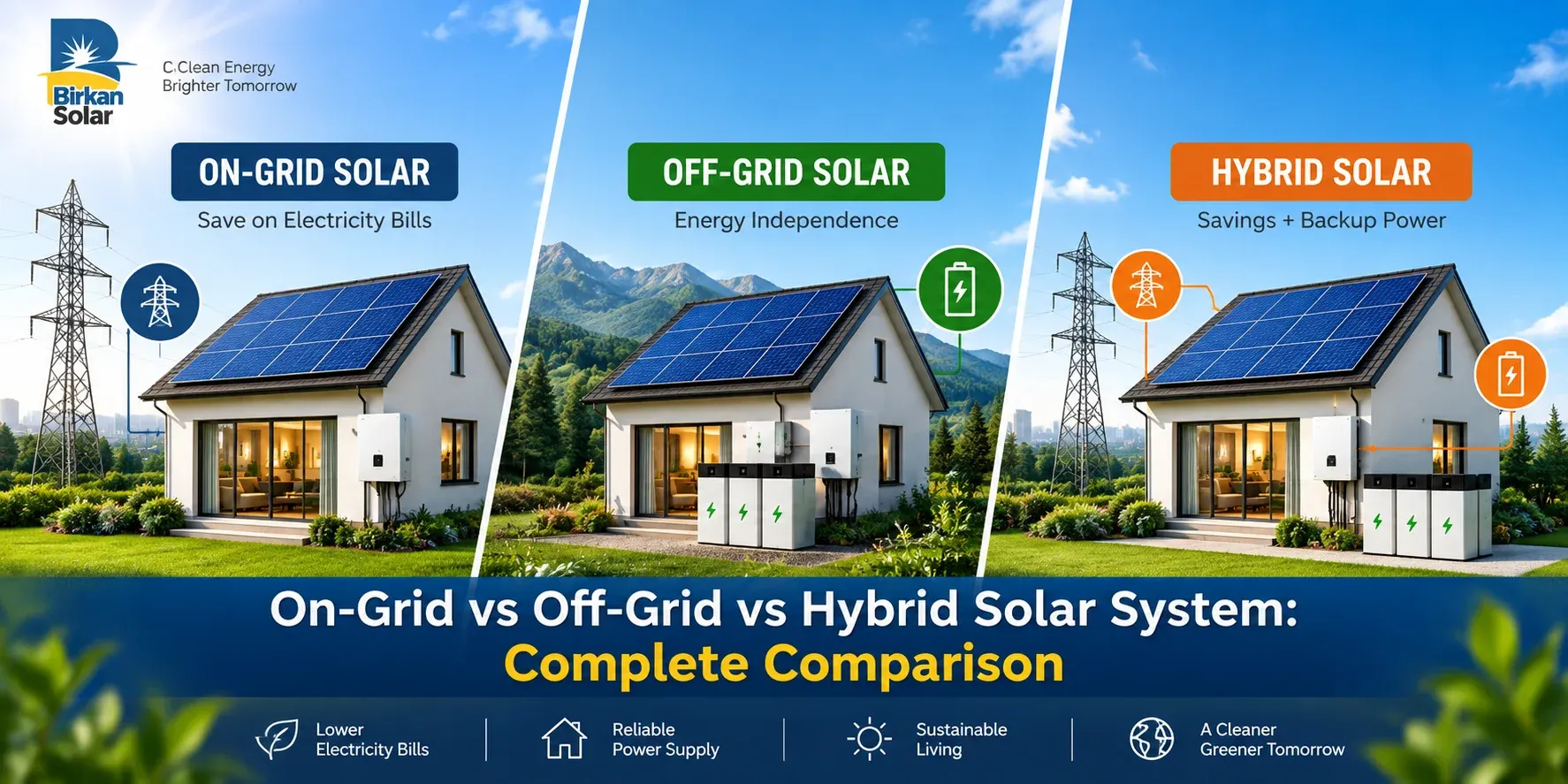
Choosing between an on-grid, off-grid and hybrid solar system is one of the most important decisions in a home solar project. The panels may look similar from the outside, but the way each system uses the grid, stores electricity and responds to a power cut is very different. Selecting the wrong configuration can lead to unnecessary battery costs, limited backup or lower-than-expected savings.
The right choice depends on how much electricity your home uses, when it uses it, how reliable the local grid is, whether backup power is essential, how much roof space is available and what you want the system to achieve. An on-grid system may be practical for a homeowner focused on bill reduction. An off-grid system may be necessary where the grid is unavailable. A hybrid solar system can suit homes that want solar savings with battery-backed power for selected loads.
This home solar comparison explains how the three options work, where each one fits, what they cost in broad terms, and what to check before requesting a final quotation.
Which Solar System Is Best for a Home?
An on-grid solar system is usually the simplest choice for reducing electricity bills where the utility grid is available and reasonably reliable. An off-grid solar system is designed for homes that cannot depend on the grid and therefore needs sufficient battery storage. A hybrid solar system combines solar, batteries and the grid, making it suitable when the homeowner wants both bill reduction and backup power. The best option depends on the property, usage pattern, outage requirements and budget.
What Is the Difference Between On Grid, Off Grid and Hybrid Solar?
The main difference is the role of the electricity grid and batteries. An on-grid system is connected to the utility grid and normally works without batteries. An off-grid system operates independently and uses batteries to supply power when sunlight is unavailable. A hybrid system connects solar panels, batteries and the grid through an inverter that manages energy between them.
The three configurations can use similar panels and mounting structures, but their inverters, battery requirements, control logic, backup circuits and approvals can be different. This is why comparing only the panel capacity can give an incomplete picture of the project.
Comparison of On Grid Off Grid and Hybrid Solar Systems
| System type | Grid connection | Battery requirement | Power during outage | Best suited for | Main trade-off |
|---|---|---|---|---|---|
| On-grid | Yes | Usually no | Normally no | Homes focused on bill reduction | Depends on grid availability |
| Off-grid | No utility dependence | Essential | Yes, within designed limits | Remote homes or unreliable-grid locations | Higher storage and planning requirements |
| Hybrid | Yes, with battery backup | Usually yes | Yes, for selected or designed loads | Homes wanting savings and backup | Higher upfront cost |
1. How an On Grid Solar System Works
An on-grid solar system sends electricity from the panels to an inverter, which converts it into AC power for household use. When the home needs more power than the panels are producing, electricity is drawn from the grid. When generation exceeds immediate consumption, surplus electricity may be exported under the applicable metering and utility rules.
This arrangement makes an on-grid system relatively straightforward. It can use daytime solar generation without the added cost of a battery bank, and the grid remains available when solar output falls because of night, clouds or higher demand. For many urban homes, the main objective is to reduce the amount of electricity purchased from the utility.
There is an important limitation: a standard on-grid inverter normally shuts down during a grid outage. This is a safety function that prevents the system from feeding electricity into a line that utility workers may be repairing. If backup power is required, the homeowner should evaluate a hybrid system instead of assuming that an on-grid system will operate during a power cut.
When Is On Grid Solar a Good Choice?
On-grid solar is often worth considering when the home has a reliable utility connection, the roof receives useful sunlight, and the primary goal is to reduce electricity bills. It may also be suitable when the homeowner does not want to manage batteries or does not need backup for essential loads.
Before selecting it, check the local rules for connection, net metering or other energy-settlement arrangements. The financial outcome depends on the tariff, consumption pattern, system design and applicable policy. A supplier should not promise a fixed saving without reviewing these factors.
2. How an Off Grid Solar System Works
An off-grid solar system is designed to operate without relying on the utility grid. Solar panels supply daytime loads and charge batteries. The batteries then provide energy during the evening, at night or when sunlight is temporarily unavailable. An inverter manages the conversion and supplies AC power to the home.
The design must account for the home’s daily energy use, peak demand, motor starting currents, cloudy periods, battery depth of discharge and seasonal changes. A system that only matches average daytime consumption may fail at night or during several low-sun days. Off-grid planning therefore requires more than selecting a panel count.
Battery capacity is a major part of the system cost. The homeowner should understand usable storage, not only nominal battery capacity, and should plan for battery maintenance, operating conditions and eventual replacement. Essential loads may need to be separated from high-consumption appliances so that stored energy lasts longer.
When Is Off Grid Solar a Good Choice?
Off-grid solar can suit remote homes, farms, holiday properties or locations where a utility connection is not available or is highly unreliable. It can also be considered when extending the grid would be difficult or expensive.
The system must be sized conservatively and operated with clear load priorities. Air conditioners, electric heaters, pumps and other high-power appliances can require a much larger inverter and battery bank than lights, fans and communication equipment. Ask for a load schedule that shows which appliances the proposed system can run and for how long.
3. How a Hybrid Solar System Works
A hybrid solar system combines solar panels, batteries and the utility grid. During the day, solar power can run household loads and charge the battery. Stored power may be used later in the evening or during an outage. When solar and battery energy are insufficient, the home can draw power from the grid.
The hybrid inverter is central to the design. It decides how energy flows between the panels, battery, home and grid according to programmed priorities. Depending on the equipment and design, the homeowner may prioritise self-consumption, battery backup, time-based use or selected critical loads.
Hybrid does not automatically mean that the entire house will run during a power cut. Many systems back up a separate circuit for lights, fans, router, refrigerator or other essential appliances. The quotation should clearly state the backed-up loads, expected backup duration and battery assumptions.
When Is Hybrid Solar a Good Choice?
Hybrid solar is worth considering when the home has a grid connection but also experiences outages, or when the homeowner wants to use more solar power after sunset. It can provide more control than a basic on-grid system, but the added battery and inverter capacity increase the initial investment.
A hybrid system is most useful when the backup requirement is defined. A homeowner who wants to run the entire house, including air conditioning and water heating, needs a very different system from someone who only wants essential lighting, fans, Wi-Fi and a refrigerator during outages.
On Grid vs Off Grid vs Hybrid: Cost and Value
The total cost depends on capacity, panel and inverter models, mounting structure, cable runs, protection devices, installation conditions and, in off-grid or hybrid systems, battery size and technology. In broad terms, an on-grid system usually has the lowest upfront cost because it does not require a large battery bank. An off-grid system can cost more because it must generate and store enough energy for periods without grid support. A hybrid system falls into a wide range because its battery and backup scope can be small or substantial.
Do not compare quotations only by price per kilowatt. A low-cost hybrid quote may include a small battery that cannot support the loads the homeowner expects. An off-grid quote may use optimistic assumptions about cloudy days. An on-grid quote may exclude approval or metering support. Compare exact equipment models, battery usable capacity, expected generation, backup loads, structure, protection, installation, warranties, taxes and exclusions.
How to Choose Based on Your Home and Usage
A practical decision can begin with five questions:
- Is a utility grid connection available and reasonably reliable?
- Is the main goal bill reduction, backup, energy independence or a combination?
- What appliances must operate during a power cut?
- How much electricity is used during daylight and after sunset?
- Is there enough roof area and budget for the required panels and batteries?
If the grid is reliable and backup is not important, on-grid solar may be the most direct option. If the home has no dependable grid connection, off-grid solar may be necessary. If the grid exists but outages or evening consumption are concerns, hybrid solar may provide a better balance.
Roof and Site Checks for All Three System Types
All three systems need a suitable site. Review roof strength, age, waterproofing, drainage, access, shade, orientation and space around water tanks or rooftop rooms. The mounting structure should be selected for the roof type and local conditions, with cable routes that remain protected and serviceable.
For an off-grid or hybrid system, also identify a safe location for the inverter and batteries. The battery area should be protected from water, excessive heat, unauthorised access and avoidable mechanical damage. Equipment placement can affect cable length, voltage drop, ventilation and maintenance access.
Ask for a layout that shows panels, structure, inverter, battery, distribution board, protection devices and backup circuits. A site-specific drawing is more useful than a generic package brochure.
Approvals, Metering and Installation Scope
On-grid and hybrid systems may require utility approvals, inspections, metering or documentation depending on the location and project size. Off-grid systems may have fewer grid-connection steps, but they still require safe electrical design and compliant installation.
Before signing, confirm who will manage applications, utility coordination, inspection, metering, commissioning and documentation. If a government incentive is relevant, verify current eligibility and paperwork through the official programme or electricity distribution company. Policy details can change, so do not treat an old subsidy figure as guaranteed.
The installation scope should include mounting, panels, inverter, battery if applicable, DC and AC cables, protection, earthing, testing, monitoring setup, handover documents and after-sales support. Any exclusions should be written clearly.
What to Check in a Home Solar Comparison
Use a like-for-like comparison before making a decision. Check:
- Solar panel brand, model, number and total DC capacity.
- Inverter type, model, efficiency, warranty and battery compatibility.
- Battery chemistry, nominal and usable capacity, warranty and backup scope.
- Expected annual generation and the assumptions behind it.
- Mounting structure material, fixing method and roof protection.
- DC and AC protection, earthing, cables and emergency shutdown.
- Utility approvals, metering and documentation responsibilities.
- Installation timeline, testing, monitoring and handover.
- Product, workmanship and after-sales warranty terms.
- Taxes, transport, civil work, exclusions and final payable price.
This list prevents a simple panel-capacity comparison from hiding major differences between proposals.
Common Selection Mistakes to Avoid
One common mistake is choosing an on-grid system while expecting it to provide power during an outage. Another is selecting a hybrid system with a battery that is too small for the promised backup. Off-grid projects can fail when the design ignores cloudy periods, motor starting loads or future consumption.
Homeowners also compare brands without comparing models, accept generation estimates without assumptions, overlook roof access and approve quotations that exclude protection or approvals. These issues are avoidable when the design is reviewed as a complete system.
The lowest quote may not have the lowest long-term cost. Reliability, service response, battery replacement planning, safe installation and realistic performance should be part of the decision.
Conclusion: Select the System Around Your Real Priority
The choice between on-grid, off-grid and hybrid solar should begin with the home’s actual electricity needs. On-grid solar is generally focused on bill reduction. Off-grid solar is built for energy independence where grid support is unavailable or unreliable. Hybrid solar combines grid access with battery-backed flexibility, making it suitable for homes that want both savings and selected backup power.
Before choosing, check daytime and night-time consumption, outage requirements, roof conditions, shade, panel and inverter specifications, battery capacity, electrical protection, approvals, warranties and service support. A professional site assessment can turn these questions into a system design that matches the property instead of a generic package.
If you are comparing a home solar system, contact Birkan Solar for a consultation and site assessment. The team can help you evaluate on-grid, off-grid and hybrid options and prepare a project-specific installation proposal.
Frequently Asked Questions
1. What is the main difference between on-grid, off-grid and hybrid solar?
On-grid systems work with the utility grid and usually do not use batteries. Off-grid systems operate without grid dependence and require batteries. Hybrid systems combine the grid, solar panels and batteries to provide both solar savings and selected backup power.
2. Which solar system is best for a home?
On-grid is often suitable for bill reduction where the grid is reliable. Off-grid is designed for remote or highly unreliable-grid locations. Hybrid is suitable when the homeowner wants battery backup or more control over solar energy use. The best choice depends on site and usage.
3. Does an on-grid solar system work during a power cut?
A standard on-grid system normally shuts down during a grid outage for safety. It does not usually provide backup power unless it includes specialised backup equipment and storage designed for that purpose.
4. Is a battery compulsory for off-grid solar?
Yes, in most practical off-grid designs. Batteries store solar energy for night-time use and periods of low sunlight. The storage must be sized around the loads, backup duration and cloudy-day requirements.
5. Does a hybrid solar system power the entire home during an outage?
Not automatically. Many hybrid systems back up selected essential circuits. Running the entire home, especially air conditioners, heaters or pumps, requires a larger inverter and battery system than backing up lights, fans and communication equipment.
6. Is hybrid solar more expensive than on-grid solar?
It is usually more expensive because it adds battery storage and a compatible hybrid inverter. The actual difference depends on battery size, equipment models, backup loads, installation conditions and the desired operating strategy.
7. Is off-grid solar suitable for a city home?
It can be installed, but it may not be the most economical choice when a reliable grid is already available. The required battery bank, backup planning and maintenance can make hybrid or on-grid solar more practical for many urban homes.
8. How do I calculate battery capacity for a hybrid system?
Start by listing the appliances that must operate during an outage, their power ratings and the number of backup hours required. Then account for usable battery capacity, inverter efficiency, depth of discharge and future demand. A professional load calculation is recommended.
9. Which appliances can an off-grid solar system run?
That depends on panel capacity, inverter rating, battery storage and starting currents. Lights, fans, routers and refrigerators are easier to support than air conditioners, electric heaters, pumps and other high-power loads.
10. What should I compare in on-grid and hybrid solar quotations?
Compare panel and inverter models, total capacity, expected generation, battery usable capacity, backup circuits, structure, protection, installation scope, approvals, monitoring, warranty, service terms, taxes and exclusions.
11. Can an on-grid system be upgraded to hybrid later?
Sometimes, but compatibility depends on the inverter, wiring, space, protection and planned battery system. If backup may be needed in the future, discuss expansion capability before selecting the initial equipment.
12. Which system needs the most maintenance?
Off-grid systems usually require the most planning and maintenance because they depend fully on batteries and stored energy. Hybrid systems also need battery care. On-grid systems have fewer storage-related requirements but still need cleaning and inspection.
13. Are government subsidies available for all three solar types?
Eligibility depends on current central or state policies, system type, approved equipment, location and documentation. Confirm the latest rules with the relevant official portal and electricity distribution company before including an incentive in your budget.
14. Does roof size affect the choice between on-grid and off-grid solar?
Yes. Off-grid systems may require additional panels to charge batteries and support cloudy periods. Limited roof space can influence the achievable capacity, panel efficiency and whether the planned loads are realistic.
15. Why is a site assessment important before choosing a solar system?
A site assessment checks roof condition, shade, orientation, usable area, cable routes, equipment placement, grid connection and backup requirements. It helps the installer recommend a system based on the property rather than a standard package.
Ready to Compare Solar Options for Your Home?
A clear comparison starts with your bills, roof, grid reliability and backup priorities. Contact Birkan Solar for a consultation and site assessment to discuss the most suitable on-grid, off-grid or hybrid solar system for your home.