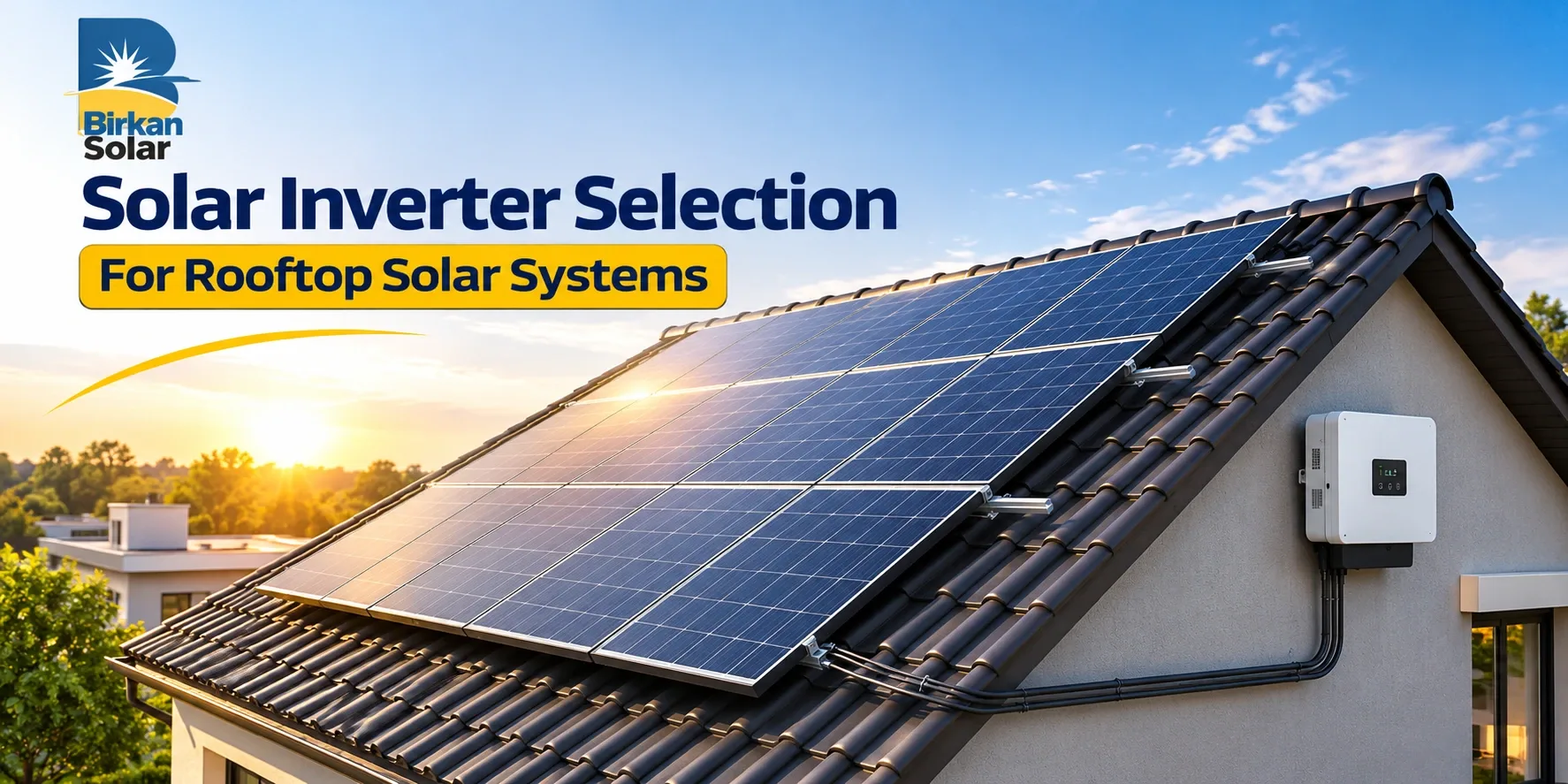
A solar inverter for rooftop solar is the operating bridge between the PV array and the electrical loads, grid connection or battery system it serves. Choosing one by headline kilowatt rating alone can create clipping, poor start-up behaviour, string mismatch, monitoring gaps or future expansion limits. A dependable selection begins with the system architecture, array electrical characteristics, roof geometry, local grid requirements, load profile and the responsibilities included in installation and after-sales support.
What a Rooftop Solar Inverter Does
Solar modules produce direct current electricity. The inverter converts that power into alternating current suitable for the connected electrical system. In a grid-connected installation, it also synchronises with grid conditions and follows required protective behaviour. In a battery-based or hybrid arrangement, the inverter may manage energy flows between PV, storage, loads and the grid, depending on the system design.
Modern inverters can also provide maximum power point tracking, operating data, fault information and communication interfaces. These capabilities are useful only when the array design, electrical protection, monitoring setup and commissioning are planned as one system. A feature list cannot compensate for incompatible voltage, poor string design or unclear service responsibility.
Birkan Solar presents rooftop, commercial and industrial applications through its solar installation solutions, so inverter selection should be connected with the intended installation rather than treated as an isolated purchase.
Start with the Rooftop System Type
| System type | How the inverter is used | Primary selection concern |
|---|---|---|
| Grid-connected | Converts PV power for on-site use and permitted grid interaction | Grid compatibility, protection, string design and monitoring |
| Off-grid | Supplies independent loads, normally with storage and charge management | Surge demand, battery voltage, autonomy and generator integration |
| Hybrid | Coordinates PV, grid, loads and batteries according to programmed priorities | Supported battery system, backup circuits, changeover and control logic |
| Module-level architecture | Uses microinverters or optimisers where roof conditions justify them | Roof access, monitoring detail, shade pattern and service approach |
The architecture should be chosen before the model. A buyer who needs daytime bill reduction on a stable grid has a different requirement from a site that needs battery-backed critical loads. “Hybrid-ready” should not be assumed from marketing language; confirm the supported battery technology, usable interfaces, operating modes and the exact equipment required for backup operation.
Central, String and Microinverter Approaches
String Inverters
String inverters are common in rooftop systems because multiple module strings can be connected to one unit with one or more MPPT channels. They can suit residential, commercial and industrial roofs when string grouping is well planned. Review the number of independent roof orientations, shading differences, string lengths and service access before deciding how many MPPT inputs are needed.
Central Inverters
Central inverters consolidate large DC capacity into fewer units and are more typical where project scale and layout support centralised equipment. They require careful DC collection, equipment-room planning, access, ventilation and failure-risk assessment. For many distributed rooftops, several string inverters may provide more practical zoning and maintenance flexibility.
Microinverters and Optimiser-Based Systems
Module-level electronics may help where roofs have multiple orientations, complex partial shading or a need for granular monitoring. They also place more electronic equipment on the roof, which affects access and replacement planning. Compare the benefit against heat exposure, roof safety, communication architecture and the installer’s ability to support the selected ecosystem.
Size the Inverter Against the Real PV Array
The correct comparison is not simply module kilowatts versus inverter kilowatts. Designers review the array’s maximum power, open-circuit voltage, operating voltage, current, temperature behaviour, string count and expected production profile. The proposed arrangement must remain inside the inverter’s permitted input limits under the expected site conditions.
DC-to-AC Ratio and Clipping
Some projects intentionally install more DC module capacity than the inverter’s AC rating because the array rarely operates at nameplate output for every hour. This can improve inverter utilisation, but excessive oversizing increases clipping and may breach manufacturer limits. The acceptable ratio depends on climate, orientation, losses, tariff logic and the actual inverter. It should be modelled rather than copied from another project.
Voltage Window and String Length
Each string must start and operate within the inverter’s voltage window while remaining below the maximum DC voltage in the coldest expected condition. Too few modules may prevent reliable operation; too many can exceed equipment limits. String calculations should use the exact module data and project temperature assumptions, with a documented margin and manufacturer review where required.
Current Limits and Parallel Strings
High-current modules require attention to the inverter’s input-current and short-circuit-current limits. Parallel strings feeding one MPPT add current. A physically compatible connector does not prove electrical compatibility. The design should confirm input ratings, cable size, protective devices and the approved connection arrangement.
Match MPPT Channels to Roof Geometry
Maximum power point trackers allow the inverter to operate groups of modules at appropriate electrical conditions. Arrays with different orientations, tilt angles, module types or stable shading patterns should not be combined on one tracker without engineering review. Grouping mismatched strings can reduce the energy harvested from the better-performing section.
The rooftop solar system page helps frame the wider roof, load and installation context that must be considered before the inverter layout is frozen.
- Count genuinely different roof orientations and shading conditions.
- Check how many strings each MPPT accepts and whether string currents remain within limits.
- Keep module type and string length consistent on the same tracker unless the manufacturer permits otherwise.
- Reserve inputs only when a documented expansion plan supports them.
- Map the physical roof strings to labels, drawings and monitoring channels.
Check Grid, Load and Backup Compatibility
A grid-connected inverter must suit the project’s phase configuration, voltage, frequency, connection arrangement and applicable utility requirements. Approval conditions can change by project location and connection category, so the installer should confirm current requirements with the relevant authority or DISCOM before procurement. Do not assume that a model accepted elsewhere will automatically be accepted for the present site.
For backup systems, identify the circuits that must remain live, their running power, starting currents and acceptable transfer behaviour. A hybrid inverter’s headline rating may not describe its backup output, overload duration or supported unbalanced loads. Define the critical-load board and operating sequence before equipment selection.
Commercial projects should also compare the inverter decision with the full commercial solar panel solutionincluding roof use, demand profile, metering and installation responsibilities.
Efficiency, Thermal Conditions and Installation Location
Peak efficiency is only one data point. Review the efficiency curve across expected loading, standby consumption and the way the solar inverter for rooftop solar limits output at high temperature. Rooftop sites can be hot, dusty and exposed. The selected location should follow manufacturer requirements for shade, clearance, ventilation, ingress protection and access while keeping cable routes practical.
An inverter mounted in direct sun or a poorly ventilated enclosure may operate at higher internal temperature and reduce output to protect itself. Conversely, placing equipment in an inaccessible locked room can complicate inspection and emergency response. The final location should balance environmental protection, electrical safety, security, cable length and maintainability.
Monitoring and Data Requirements
Monitoring should answer operational questions: Is the system producing as expected? Which inverter or string has a fault? Has communication stopped, or has generation actually fallen? Confirm whether the platform shows real-time and historical data, alerts, user roles, export options and inverter-level detail. Also establish who owns access credentials and who responds to alarms after handover.
Reviewing completed solar project examples can help buyers prepare project-specific questions, although the final design must still be based on their own roof and electrical conditions.
Protection, Documentation and Serviceability
- Confirm required DC and AC isolation, overcurrent protection, surge protection and earthing coordination.
- Check compatible connectors, cable ranges, torque requirements and enclosure entries.
- Obtain datasheets, manuals, warranty terms, communication instructions and approved single-line diagrams.
- Record serial numbers, firmware where relevant, commissioning settings and platform credentials.
- Clarify replacement lead time, local support process and responsibility for diagnosis.
- Keep safe access around the inverter and maintain required clearances after other services are installed.
Warranty duration should not be read in isolation. Review what is covered, who removes and reinstalls a failed unit, whether transport is included, which operating conditions can void coverage and how generation loss is handled. A long document is not the same as practical local service.
Solar Inverter Selection Checklist
- Define whether the system is grid-connected, off-grid, hybrid or module-level.
- Confirm load profile, critical loads, phase arrangement and any battery requirement.
- Freeze the exact module model, quantity, orientation, tilt and shading zones.
- Calculate string voltage and current across expected temperature conditions.
- Match strings and roof zones to the available MPPT channels.
- Model the DC-to-AC ratio and expected clipping rather than using a generic rule.
- Verify current grid and utility requirements for the project location.
- Review efficiency, temperature derating, enclosure rating and mounting environment.
- Specify monitoring, alerts, data ownership and response responsibilities.
- Compare warranty, service network, spare availability and documented commissioning scope.
Common Buying Mistakes
Common errors include buying by price per kilowatt, mixing strings from different roof conditions on one tracker, ignoring high module current, assuming a grid inverter provides backup, and approving a substitute without repeating electrical checks. Another mistake is treating Wi-Fi availability as a complete monitoring plan. Communication, data retention and alarm response need defined ownership.
The company’s solar installation and AMC backgroundis relevant because inverter performance depends on design, commissioning, monitoring and ongoing maintenance working together.
Worked Rooftop Inverter Selection Scenarios
Scenario 1: Simple Unshaded Residential Roof
A compact home roof may have one or two clear planes with the same orientation and limited shade. A string inverter can be an efficient solution when the module strings are electrically compatible and the equipment can be installed in a protected, ventilated and accessible location. The designer still needs to calculate maximum open-circuit voltage at the lowest expected temperature, operating voltage at hotter module conditions and string current against the inverter input limits. The household should also understand that a standard grid-connected inverter usually does not power the home during an outage.
If the owner expects future battery backup, that requirement should be declared before purchasing the inverter. Retrofitting storage can require additional equipment or a different architecture. It is better to compare the cost and operational implications at design stage than assume every product labelled solar-ready offers the same battery or backup capability.
Scenario 2: Commercial Roof with Multiple Orientations
A commercial building may have east-facing and west-facing roof areas, varying parapet shade and sections reserved for services. These zones should be mapped to suitable MPPT inputs so strings with different production profiles do not unnecessarily constrain each other. The designer should confirm the allowed number of strings per input, combined current and voltage window. A slightly higher equipment price can be justified when additional trackers improve layout flexibility, fault isolation or future serviceability.
The commercial buyer should also ask how production data will be used. A dashboard that shows only total daily energy may not help maintenance staff locate a weak string or communication fault. Define alert routing, user roles, data retention and the response process. If the facility has demand management goals, the inverter and monitoring system may need to integrate with meters or a broader energy-management platform.
Scenario 3: Industrial Roof with Critical Continuity Needs
Industrial rooftops can involve high connected loads, three-phase distribution, multiple transformers, dust, heat and operational restrictions on shutdowns. Inverter selection must therefore be coordinated with the electrical single-line diagram, protection philosophy, earthing, surge protection and available interconnection point. The project team should review whether several smaller inverters provide useful redundancy and maintenance flexibility or whether fewer larger units simplify equipment and cabling. The answer depends on site layout, service resources and financial modelling.
Solar generation alone does not guarantee continuity during a grid failure. If certain processes or safety systems require backup, those loads must be identified and separated, then supported through a properly designed storage, UPS or generator arrangement. The solar inverter for rooftop solar architecture, transfer method, protection and operating sequence must be engineered together. Marketing descriptions such as hybrid or backup-ready are not a substitute for a documented operating design.
How to Compare Inverter Proposals Fairly
Create a comparison schedule using the same inputs for every bidder: exact module model and quantity, string plan, roof zones, DC-to-AC ratio, phase connection, monitoring scope, mounting environment and warranty assumptions. Ask bidders to state exceptions instead of quietly changing the design. Compare the guaranteed scope, not only the inverter nameplate rating. One proposal may exclude communication hardware, AC protection, surge devices, platform subscriptions or commissioning support that another includes.
Efficiency figures should be read alongside operating conditions. A small difference in a headline maximum value may matter less than correct string matching, temperature behaviour and uptime. Review efficiency curves where available, standby consumption, derating, enclosure requirements and manufacturer instructions. For sites with high ambient temperature or limited ventilation, the designer should calculate realistic operating conditions and provide clearances rather than relying on laboratory headline values.
Service evaluation should be practical. Identify who receives the fault call, what remote diagnostics are available, whether authorised support is local, expected replacement lead time and which party handles safe isolation and reinstallation. Ask for the warranty document before purchase. Record equipment serial numbers, commissioning settings, credentials and acceptance test results so that a future service team is not forced to reconstruct the system from labels on site.
Commissioning and Handover Tests
Before energisation, the installer should verify polarity, string voltage, insulation, connector compatibility, protection settings, earthing and torque according to the approved design and applicable requirements. At start-up, compare the actual string and inverter values with expected conditions, confirm that no input is unintentionally idle and test communication. The handover should demonstrate normal shutdown, alarm viewing and the owner’s access to the monitoring platform.
A useful acceptance record includes the final single-line diagram, string map, datasheets, settings, photographs, warranty documents and support contacts. It should also define the first performance review after the system has operated for a representative period. Early review can identify communication gaps, shading changes, tripping or configuration errors before they become months of unexplained underperformance.
Frequently Asked Questions
1. What size inverter is needed for rooftop solar?
It depends on the module array, expected production, permitted DC-to-AC ratio, grid connection and manufacturer limits; it should be engineered for the site.
2. Can the inverter be smaller than the solar panel capacity?
Sometimes a higher DC array rating is intentional, but the ratio and clipping must be modelled and remain within the inverter manufacturer’s limits.
3. What is an MPPT?
It is a control function that operates a PV input near its maximum power point. Multiple trackers can separate roof zones with different conditions.
4. Is a hybrid inverter the same as a grid-tied inverter?
No. A hybrid inverter can coordinate batteries and backup functions when designed for them, while a standard grid-tied model may shut down during a grid outage.
5. Does every rooftop need microinverters?
No. They may suit complex roofs or module-level monitoring needs, but string inverters can be more appropriate for many well-grouped arrays.
6. Where should a solar inverter be installed?
In a secure, accessible and ventilated location that follows the manufacturer’s environmental, clearance and mounting instructions.
7. Why is string voltage important?
The string must operate within the inverter’s MPPT range and stay below its maximum input voltage under expected temperature conditions.
8. Can different module types share one MPPT?
Usually they should be kept separate unless their electrical behaviour and the inverter manufacturer’s guidance support the proposed arrangement.
9. What monitoring features matter?
Useful features include production history, fault alerts, inverter-level visibility, data export, clear user access and a defined support response.
10. How long does an inverter warranty last?
Terms vary by model and supplier. Compare coverage, exclusions, service process, labour responsibility and replacement logistics, not duration alone.
11. Can an inverter be added for future expansion?
Expansion should be planned with spare roof area, electrical capacity, input limits and compatible future equipment; unused capacity alone is not enough.
12. Who should approve the final inverter?
The qualified system designer and installer should confirm compatibility with modules, strings, grid requirements, loads, protection and the agreed project scope.
Choose an Inverter That Supports Reliable Rooftop Solar Performance
A good inverter selection is the result of verified inputs: exact modules, string calculations, roof zones, grid conditions, loads, monitoring needs and service responsibilities. When those decisions are documented before procurement, the inverter becomes part of a coherent rooftop system instead of a separately purchased box.
Share your roof details, electricity load, proposed PV capacity and backup expectations through the Birkan Solar Contact Us pageto discuss an inverter and rooftop system configuration suited to the actual site.